Cause of Color : Cr and / or V, with varying amounts of Iron.
Chemical Composition : Beryllium Aluminium Silicate (Be3Al2(SiO3)6; Trace elements are Cr, V, Fe, Mn, etc.
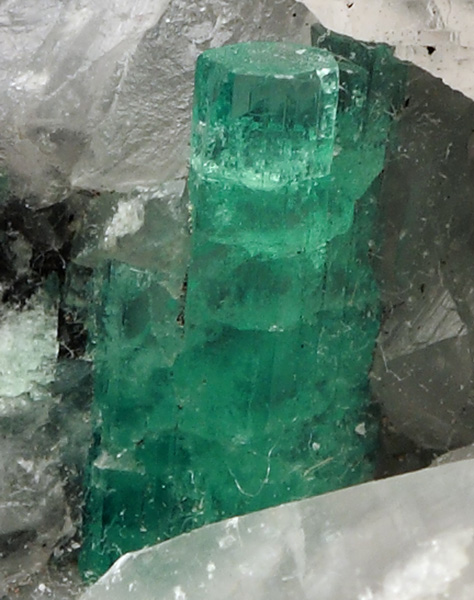
Crystal System / Forms : Hexagonal System
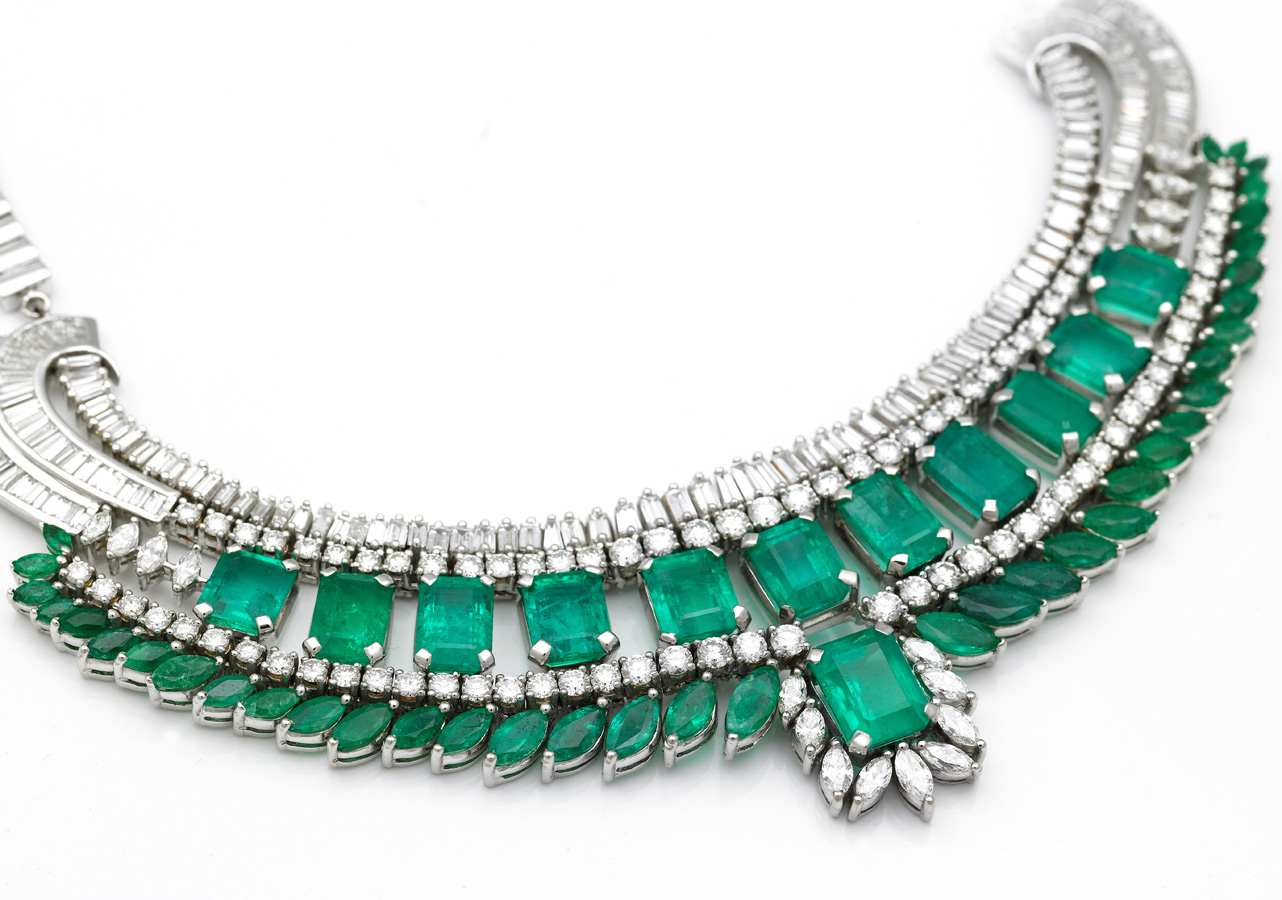
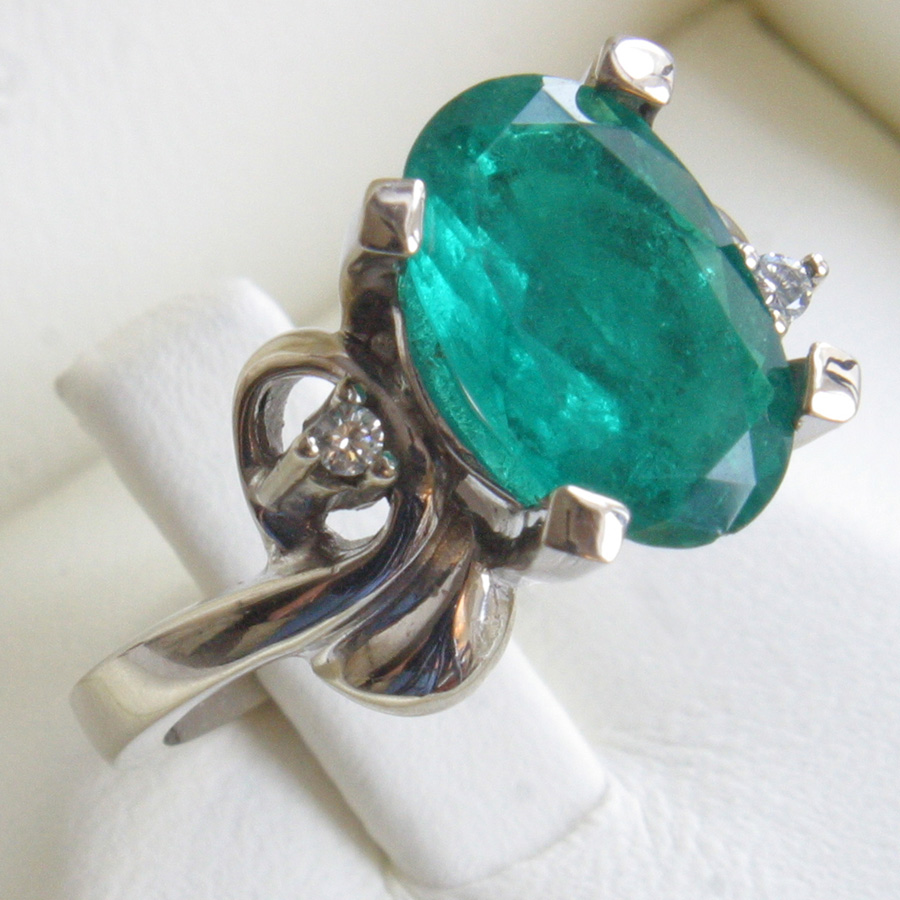
Cuts & Uses : Facetted cuts, cabochons, beads, carvings, etc.
Dispersion : 0.014
Hardness : 7.5 - 8
Lustre : Vitreous.
Magnification :
- Colombian Emerald from Colombia (Muzo, Chivor): Jagged three-phase, two phase and other fluid inclusions. Crystals (pyrite – Chivor, calcite – Muzo). Six black spokes of carbonaceous material in Trapiche emeralds.
- Transvaal (Cobra Mine): Crystals (molybdenite, biotite), fluid and phase inclusions.
- Tanzania (Lake Manyara): Crystals (orthoclase, biotite, quartz), fluid and phase inclusions.
- Pakistan (Swat Valley): Growth tubes, negative crystals, fluid, phase and crystal (dolomite) inclusions.
- Brazil: Parallel growth tubes, crystal inclusions (biotite, chromite, pyrite, dolomite).
- Zimbabwe (Sandwana): Curved tremolite fibers, garnet crystals with a yellow halo, fluid and phase inclusions.
- India (Rajasthan): Parallel rectangular two phase inclusions, crystal inclusions (biotite).
- Zambia (Kitwe, Kafubu, Miku): Crystal inclusions (magnetite, rutile, muscovite, hematite), limonite filled tubes, phase and fluid inclusions.
- U.S.S.R. (Ural Mountains): Actinolite blades, biotite flakes, fluid, phase and crystal inclusions.
Optic Character : Anisotropic, D.R.; Uniaxial Negative.
Pleochroism : Distinct dichroism depending on depth of color.
Refractive Index / Birefringence : 1.577 – 1.583 / 0.006 – 0.009. R.I. Range: 1.57 – 1.60
Simulants (with separation tests) : Synthetic emerald (inclusions), glass (optic character, inclusions), fluorite (optic character, U.V. fluorescence, R.I., S.G.), apatite (R.I., S.G., spectrum), dioptase (R.I., S.G., cleavage), aventurine quartz (structure, inclusions, R.I.), composite (inclusions, spectrum).
Sources : South America (Colombia; Brazil), Africa (Zambia; Nigeria; Zimbabwe; Tanzania; Transvaal; Mozambique; Madagascar), Pakistan (Swat), Afghanistan (Pancher), India (Rajasthan, Orissa), Russia (Ural Mountains), Austria (Habachtal), Australia
Specific Tests : Emerald is brittle and may crack when exposed to heat.
Spectrum : Strong lines at 685nm, 680nm, 640nm, band at center 600nm, lines at 477.5nm and 472.5nm
Synthesis : Flux fusion and hydrothermal method, emerald overgrowth by hydrothermal method

Leave a Reply
You must be logged in to post a comment.