
This method is closest to that of nature. This process was first used for the synthesis of Quartz for use in industry. In 1960, the first hydrothermal emerald was brought by Lechleitner. Over the years this process has advanced to such an extent as to almost completely simulate natural emeralds. The major differences still lie in the study of inclusions and structural differences.
How gemstones are synthesized by hydrothermal process?
- A steel autoclave or bomb (in effect, a pressure cooker) is used.
- Crystals are grown in a sealed environment at very high temperatures and pressures.
- Seed crystal wafers (plates) of the desired material are hung in the upper portion of the vessel and lumps of powder of the desired material (nutrient) are placed in the bottom.
- The vessel is partially filled with water and sealed.
- Heat is applied from the base and the material dissolves in the water, forms as a supersaturated solution, rises to the top of the autoclave until all the available material has been deposited on the seed crystal wafers.
- Large well formed crystals are produced. Quartz crystals in excess of eighteen inches in length and 1.5 to 2 inches in diameter are produced.
- The size of the end product depends mainly upon the seed water, the amount of feed solution, and the length of time involved.
Gemstones synthesized by hydrothermal with its identification.
- Synthetic Quartz:
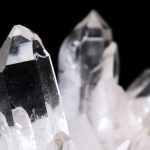
- Synthetic quartz has similar physical and optical properties as the natural counterparts.
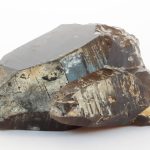
- Synthesized in colourless, smoky, amethyst, citrine, parti-coloured (ametrine), blue and green varieties.
- Most synthetic quartz is untwined and therefore exhibits circular interference colours when viewed under cross polars along the optic axis direction.
- Synthetic quartz produced using natural twinned quartz seed crystals tend to exhibit partial Brazil law twinning in a flame like manner when viewed under cross polars along the optic axis direction.
- Under magnification color zoning, whitish pinpoint inclusions – bread-crumb inclusions and seed plate inclusions are seen.
- Synthesized by Sawyer Research Products (U.S.A), Russia etc.
- Synthetic Emerald:
- Synthetic emerald has similar physical and optical properties as the natural counterparts.
- Under magnification veil-like inclusions, nail head spicules, parallel growth structures, chevron (growth features), hound’s tooth structures, seed crystal, phenakite crystals, hexagonal and triangular platelets are seen.
- Synthesized by Linde / Regency, Biron, Russia, Lechleitner, Agee, Tairus and Malossi.
- Synthetic Ruby / Sapphire:
- Synthetic ruby / sapphire have similar physical and optical properties as their natural counterparts.
- Under magnification veil-like inclusions, nail head spicules, growth zoning, chevron (growth features – Christmas tree-like effect), seed crystal, hexagonal and triangular platelets are seen.
- Synthetic Beryl:
- Synthetic beryl has similar physical and optical properties as the natural counterparts.
- Synthesized in a number of different colours – blue, pink, yellow, violet etc.
- Under magnification veil-like inclusions, nail head spicules, parallel growth structures, chevron (growth features), hound’s tooth structures, seed crystal, phenakite crystals, hexagonal and triangular platelets are seen.
- Synthesized by Russia, Crystal Research Co. (Australia), etc.



Leave a Reply
You must be logged in to post a comment.