Coral

Coral - Corallium Rubrum

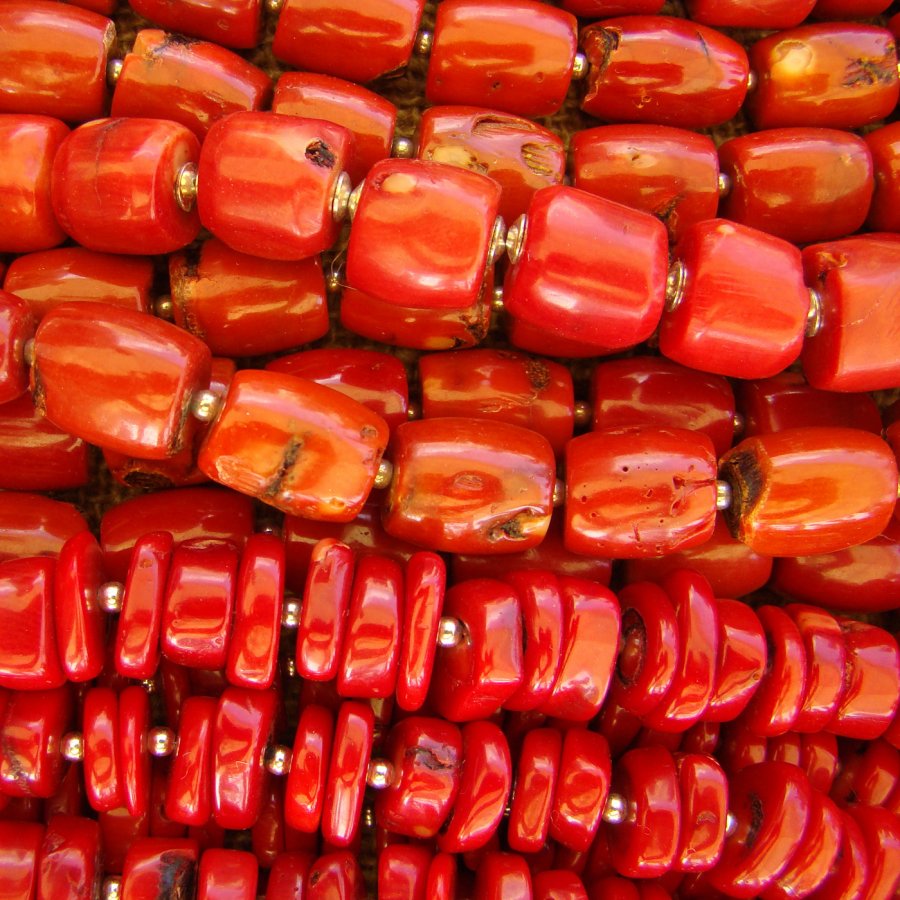
Meaning: Coral (Indian: Moonga; Italian: Corallo) is an organic substance formed as a branch like calcareous framework by a microscopic marine organism known as coral polyp. It is formed by the accretion of colonies of these tiny marine animals. The two main species are the corallium rubrum and corallium nobile.

Bamboo corals (Gorgonian Coral) from Taiwan are less-expensive, highly porous and gray to white color which are dyed in several colors, mostly in red, and sold as red coral. Absence of closely packed parallel line on the surface of sea bamboo coral is the key identifying feature to separate it from red corals. Generally, the gap between two parallel lines on the surface of sea bamboo coral is much more than that found on natural red coral.
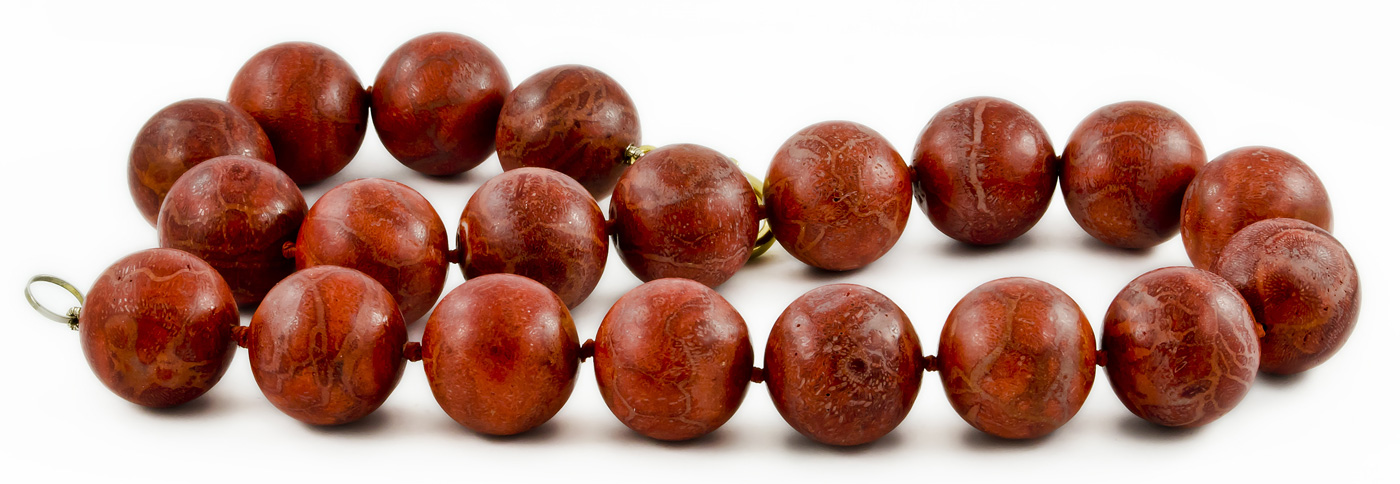
Natural corals are sourced off the coasts of Hawaii which is then exported to Italy (called Italian coral) and then re-exported through out the world. Natural coral with combination of red and orange color (red color being primary while orange color being secondary) has the best value. Golden coral is precious due to its rarity; pink and red coral is used as bead in jewelry.

Properties
Chemical Composition: 
Calcium Carbonate - CaCO3; small percent of magnesium carbonate - MgCO3 (3%); trace of Iron oxide and 1.5% - 4% organic matter.
Classification / Type: 
Types of Coral
  1. Calcareous Coral: Carbonate type (white, pink, red and orange) display a distinctive pattern of parallel stripes of slightly different color and transparency.
  2. Conchiolin Coral: Horny type (black, blue, golden and brown) display a concentric structure about the axis of the original branch. Generally, golden coral displays a distinctive fine pimply appearance, in addition to a concentric structure and is some cases a faint sheen.
Colors / Varieties: 
White, pink, red, orange, blue to violet, golden, brown and black. Transparency: Semi-translucent to opaque.
Crystal System / Forms: 
None. Occurs in a branch like form.
Hardness: 
3.5
Specific Gravity: 
  • Calcareous Coral: 2.60 - 2.70
  • Conchiolin Coral: 1.30 - 2.20
Cleavage / Fracture: 
None / Conchoidal to Uneven.
Optic Character: 
Generally A.G.G. or opaque.
Lustre: 
Waxy to vitreous.
Refractive Index / Birefringence: 
  • Calcareous Coral: 1.486 - 1658 / 0.172
  • Conchiolin Coral: 1.56
Pleochroism: 
None.
Dispersion: 
None.
Magnification: 
Wavy, parallel (whitish line along the length of the stone), fibrous structure, tiny cavities (polyp holes); conchiolin coral (horny type coral) may exhibit tree-ring structure.
U.V. Fluorescence: 
Mostly inert or dull purplish red.
Spectrum: 
Not diagnostic.
Treatment (Enhancement): 
Specific Tests & Remarks: 
  • Calcareous Coral: Reacts with vigorous effervescence to dilute acids, such as hydrochloric acid (HCl).
  • Conchiolin Coral: Does not effervesce with acids. Black coral may be carefully tested with a hot point for its characteristic burnt hair odor.
Synthesis: 
Gilson created coral (reconstructed coral): No parallel lines (veins) but dark angular spots or patches are seen.
Simulants (with key separation tests): 
Glass (structure, S.G.); Plastic (structure, hot point); Shell (structure); Stained marble (structure); Conch pearl (structure); Wood (structure); Horn (structure), etc.
Geological Occurrence: 
Sea bed.
Sources: 
Grows in warm seas (13°C - 16°C), found off the coasts of Hawaii, from the Bay of Biscay through into the Mediterranean sea, Red sea, Japanese coast. Black coral is found off the Cameroon coast.
Cuts & Uses: 
Used for beads, carving and cabochons, rough coral branches sometimes strung into necklaces, carved into ornaments.

Did you know?

Jewellery is one of the most bought products online. An estimated $1 billion USD of diamonds are bought annually via the Internet. Over 40 million people use the Internet to trade!

In Germany, the garland of ambers is hung around the necks of the infants, so that their teeth might come out without much trouble.

In Turkey, people fix a piece of amber in the hubble-bubble, dogged by an age old belief that the presence of the jewel would destroy all the germs and no disease would spread, even after many have dragged their puffs from it.

In Greece, people think if wine is poured into the cups made of amethyst, one does not get drunk after drinking that.

In Rome, a talisman having coral pieces is considered very auspicious to quell the bad spells of evil look. The Romans were in the habit of hanging chains made of ancient coral pieces from the cradle of the infants to protect them from evil effects.

In China, people wear rings studded with tiny conch or oyster shells as they believe it cures all aches such as stomach ache, worms and like.

In India, pendants made of silver and studded with pearls are hung from the necks of the children to save them from any bad effects.

Greeks still believe, if women wear blue sapphires then no sense of immorality would pollute their mind nor can any fear of the supernatural can trouble them.

The Pope Innocent III had circulated an order asking all the priests wear blue sapphire, so that morality can be strengthened.

It is said about turquoise, that when the stone changes its color into yellow, it actually signals bad times to the person who wears it.

It is believed that a turquoise gifted to a friend or a lover turns his or her life into one of happiness and good luck.

Poll