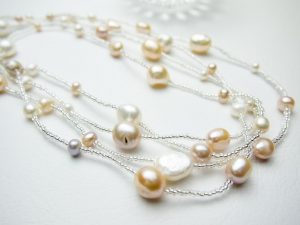
Meaning: Pearls (Indian: Moti; Italian: Perla) are classified into two basic categories - Natural and Cultured. The term synthetic must not be used with respect to pearls. Materials which simulate or look like pearls, but do not have either the composition or structure, are known as imitation pearls.
Imitation Pearl are products, completely or partially man-made, imitating the appearance, colour and effect of natural or cultured pearls without possessing the physical and chemical properties, even when using natural substances.
Information on Pearls
Pearls are produce by molluscs which are saltwater oysters and freshwater mussels.
The oyster consists of a soft visceral mass enclosed between two halves of the shell which are hinged together. Like every other animal, an oyster possesses a heart, stomach and mouth. It breathes through its gills and feeds itself with micro-organisms and planktons in the water.
Pearl Oysters belong to the Pinctada family of the mollusc group in class Lamellibranchia. Pinctada molluscs are saltwater oysters. Molluscs like Unio and Hyriopsis are freshwater mussels.
The shell is composed of various layers.
The first layer is dark horny outside layer composed of organic substance conchiolin, a protein like substance.
It is also the binding agent that holds the aragonite crystals together.
The inner layer is a thicker crystalline layer of prismatic calcium carbonate in the form of calcite.
Mother of Pearl is the smooth pearly lining (layer) on the interior of a mollusc shell. It is composed of CaCO3 as aragonite crystals and a little water and conchiolin.
Aragonite layer is made up of microscopic platy calcium carbonate crystals arranged in an overlapping manner.
Nacre is a protective pearly substance secreted by the mollusc and deposited around an irritant, in layers. These layers decide the lustre and quality of a pearl. The thinner the layer, the better is the lustre and vice versa.
Mantle is a fold of epithelial material that envelopes the internal organs of the animal and is situated at the meeting point of the inner sides of the shell. It secretes conchiolin, aragonite and calcite.
Orient of a pearl results from the diffraction of the light through the aragonite crystals.
When white light is reflected from two different surfaces very close together, the two reflected waves can be out of phase, which causes interference, resulting in rainbow colours.
The finer the pearly layers, the greater the orient that the pearl will possess.
Pearl Enhancement
Skinning: It is performed by removing a bad coloured or blemished outer layer, so that a more attractive, although smaller, pearl could be obtained. The layer is removed by careful filing or by the use of abrasive emery paper.
Soaking: Cracks in the surface of pearls are sometimes cured by soaking them in warm olive oil.
Coloured Impregnation (Dyeing): Staining is commonly done on Akoya pearls. The pearls are soaked in a weak solution of silver nitrate and dilute ammonia and then exposed to light or hydrogen sulphide gas. Occasionally the core (bead nuclei) is dyed before they are inserted in the oyster to produce a different overall colour. It is performed on white pearls to change them into black pearls.
Coating: Pearls may be coated with any pigment to give different colours.
Bleaching: Removal of a secondary colour or stains from the deposit of organic matter. This is done by immersing the pearls in a solution of oxygenated water and afterwards exposing them to light.
Irradiation: Some pearls are darkened by treating them with gamma rays. Commonly Akoya pearls are treated to various coloured shades. X-rays may give a reduced silver shade.
Most pearl enhancements are difficult to detect with conventional equipment. Enhancements such as skinning and bleaching are often considered as part of the processing of pearls by traders.
Pearls produced by Snails:
Abalone Pearls: Found off the coast of New Zealand, California, Mexico, Japan and Korea. These pearls are known for their almost opal like appearance. The colours may be any combination of green, blue, pink or yellow and usually have an irregular shape.
Conch Pearl: These pearls are found in the great Conch, a large marine snail found throughout the Caribbean. Commonly pink, white or brownish. They are also called 'pink pearls' and may have distinctive flame like surface markings. These pearls do not have a nacreous coating and appear more as corals.
Difference between Pearl and Mother of Pearl is minor and varies in their structures and the proportions of their components.
Comparing a pearl and a ball of mother-of-pearl, it will be seen that the pearl has lustre over its entire surface, whereas the ball of mother-of-pearl has this in only two places. This is because their structures are totally different.
The mother-of-pearl has relatively flat layers, whereas the pearl has been formed around a nucleus in concentric layers.
The components of pearls or mother of pearl are affected by the food, the salinity, the water temperature and the region where the oyster-beds are found.
Pearl
Mother of Pearl
Calcium Carbonate (Aragonite)
91.72%
84.75%
Organic Material (Conchiolin)
5.94%
11.76%
Water
2.23%
3.17%
Other Substances
0.11%
0.50%
Did you know?
Jewellery is one of the most bought products online. An estimated $1 billion USD of diamonds are bought annually via the Internet. Over 40 million people use the Internet to trade!
In Germany, the garland of ambers is hung around the necks of the infants, so that their teeth might come out without much trouble.
In Turkey, people fix a piece of amber in the hubble-bubble, dogged by an age old belief that the presence of the jewel would destroy all the germs and no disease would spread, even after many have dragged their puffs from it.
In Greece, people think if wine is poured into the cups made of amethyst, one does not get drunk after drinking that.
In Rome, a talisman having coral pieces is considered very auspicious to quell the bad spells of evil look. The Romans were in the habit of hanging chains made of ancient coral pieces from the cradle of the infants to protect them from evil effects.
In China, people wear rings studded with tiny conch or oyster shells as they believe it cures all aches such as stomach ache, worms and like.
In India, pendants made of silver and studded with pearls are hung from the necks of the children to save them from any bad effects.
Greeks still believe, if women wear blue sapphires then no sense of immorality would pollute their mind nor can any fear of the supernatural can trouble them.
The Pope Innocent III had circulated an order asking all the priests wear blue sapphire, so that morality can be strengthened.
It is said about turquoise, that when the stone changes its color into yellow, it actually signals bad times to the person who wears it.
It is believed that a turquoise gifted to a friend or a lover turns his or her life into one of happiness and good luck.
Jewellery is one of the most bought products online. An estimated $1 billion USD of diamonds are bought annually via the Internet. Over 40 million people use the Internet to trade!