
S.G. is defined as the weight of a body compared with the weight of an equal volume of pure water.
The specific gravity of a gemstone is a ratio which could be of great help in identifying gemstones. Although a gemstone cannot normally be identified by its S.G. alone, together with other measurements this can help in narrowing down the range of possibilities.
The specific gravity of a substance is due to:
- The atomic weights of its constituent elements e.g. corundum has a higher specific gravity than quartz since it consists of heavier elements.
- The compactness of the structure formed by these constituents. E.g. diamond, with its light but compactly arranged atoms of carbon, has a higher S.G. than graphite, which consists of less densely packed atoms of carbon.
Heft: Specific gravity can be related to the heft as well as the size of a gemstone. Some gemstones are ‘heavier1 than others i.e. they have more heft. This method of sensing the S.G. of a gem, is of course very crude, but is sometimes of value when making a quick subjective assessment of a stone.
- E.g. zircon is twice as heavy as an opal of similar size.
- A one carat synthetic cubic zirconia is smaller in size then a diamond of the same weight.
How to measure S.G. of a Gemstone?
- Hydrostatic method
- Heavy liquid method
Hydrostatic Method
This direct weighing method, though time consuming, gives an accurate result except for very small stones. To simplify calculations, Archimedes Principle is applied, which states that, when a body is immersed in a fluid there is an apparent loss of weight; this loss of weight is equal to the weight of fluid displaced. Thus when a stone is immersed in water there is an apparent loss of weight equal to the weight of the water it displaces. Clearly a stone displaces its own volume of water. Therefore, the apparent loss of weight is equal to the weight of an equal volume of water.
Specific Gravity = Weight of stone in air / Loss of weight in water
The essential information necessary is as follows:
- Weight of the stone in air = (A)
- Weight of the stone in water = (B)
- Loss of weight in water (A − B)
- S.G. = A ÷ (A − B)
Method: An accurate balance is required (either a single-pan or a double-pan balance). The only difficulty is weighing the stone in the water. To do this a few adaptations have to be made.
- First of all, bridge the left-hand pan of the balance with a wooden stool (without touching the pan).
- Place a beaker of pure distilled water on it.
- Make a wire support or spiral cage for the stone under test.
- Suspend it in the beaker of water by means of a non-rusting wire (or mono-filament nylon) such that it moves freely without touching the beaker.
- To simplify calculations, a counterpoise can be fitted to the other weight pan to exactly balance the added weight of the wire cage when it is immersed in water.
- Weigh the stone in the pan in the usual manner. Suppose the weight is 5.00ct.
- Place the stone in the cage, immerse completely in the water and weight it, suppose the weight is 3.37ct.
- Weight of stone in air = 5.00ct
- Weight of stone in water = 3.37ct
- Lost of weight = 1.63ct
- S.G. = weight in air ÷ loss of weight
- S.G. = 5 ÷ 1.63 = 3.06
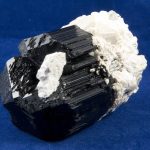
By looking up S.G. table, the stone is identified as Tourmaline.
Precautions:
- Care must be taken to remove any air bubbles adhering to the stone, the wire and the spiral cage. A small paint brush will help remove this or the use of boiled or distilled water will reduce the risk of them forming.
- The surface tension or the cohesion of the water molecule causes a drag on the wire cage as it moves in the water. This effect can be reduced by adding a drop of detergent to the water or by using a very thin suspension wire.
- Alternatively, when very great accuracy is required, replace the water by a liquid having a lower surface tension such as toluene or benzene and the resulting S.G. determination is multiplied by the S.G. of the liquid used.
- In this case it is also important to make the necessary corrections for temperature as the S.G. of these liquids are much more sensitive to temperature than water. Hence it is essential to multiply the S.G. of the liquid at the working temperature.
Disadvantages:
- The only disadvantage against hydrostatic S.G. determination is that it is time consuming.
- Mounted stones and drilled beads cannot be tested by this method.
- Porous and dyed stones might give wrong result due to water absorption.
- Stones less than 1 carat tend to give wrong readings due to surface tension.
Heavy Liquid Method
This immersion method is purely comparative and, which when done with care gives fairly good results. The principle used here is again Archimedes Principle. If a gemstone has the same S.G. as that of the liquid in which it is immersed, it would experience an upward force equal to its own weight. This is seen only when the stone is completely immersed in the liquid and floats freely within the liquid.
This method makes use of three or four liquids having S.G. between 2.65 and 4.15. The gemstone under test is immersed in each liquid in turn.
- If the stone sinks in the liquid, the S.G. of the stone is greater than that of the liquid.
- If the stone floats at the surface of the liquid, the S.G. of the stone is less than that of the liquid.
- If the stone is freely suspended within the liquid the S.G. of the stone equals that of the liquid.
The rate of rise or fall also indicates whether the S.G. of the stone is near that of the liquid or not. This rate of rise or fall is further dependent on the shape of the stone i.e. a “streamlined” cut will sink faster than a “blunt” cut.
Liquids may be sensitive to temperature variations and stones which are just floating in the liquid may sink if the beaker is warmed in the hand. Most of the liquids used are volatile and their fumes are poisonous.
Following is a list of liquids with their S.G’s & R.I.’s:
| S. No. | Liquid | S.G. | R.I. |
|---|---|---|---|
| 1. | Water | 1.00 | 1.33 |
| 2. | Benzyl Benzoate | 1.17 | 1.54 |
| 3. | Carbon Tetrachloride | 1.59 | 1.44 |
| 4. | Monobromonapthalene | 1.49 | – |
| 5. | Toluene | – | 1.49 |
| 6. | Olive Oil | – | 1.47 |
| 7. | Castor Oil | – | 1.47 |
| 8. | Xylene | – | 1.49 |
| 9. | Cedar wood Oil | – | 1.51 |
| 10. | Clove Oil | – | 1.54 |
| 11. | Canada Balsam | – | 1.54 |
| 12. | Aniline | – | 1.58 |
| 13. | Cinnamon Oil | – | 1.59 |
| 14. | Ethylene Dibromide | 2.18 | – |
| 15. | Bromoform | 2.88 | 1.58 |
| 16. | Acetylene Tetra bromide | 2.96 | 1.638 |
| 17. | Methylene Iodide(Di-Iodomethane) | 3.33 | 1.745 |
| 18. | Clerici Solution | 4.00 | – |
- Clerici solution (a mixture of thallium malonate and thallium formate in water) is highly corrosive and poisonous and therefore not recommended for general use.
- Methylene Iodide when fresh is light yellowish brown, but darkens on exposure to sunlight, due to the release of Iodine. To reduce the discoloration a piece of copper or tin is placed in the liquid.
- Bromoform also darkens when exposed to light due to the release of Bromine. In this case a small amount of mercury is added to the liquid to decolorize it.
The actual liquids may be varied to suit the needs of the users, for e.g.
| S. No. | Liquid | S.G. | Indicator Stone |
|---|---|---|---|
| 1. | Bromoform diluted | 2.65 | (indicator-quartz) |
| 2. | Pure Bromoform | 2.88 | – |
| 3. | Methylene Iodide -diluted | 3.05 | (indicator -Tourmaline) |
| 4. | Pure Methylene Iodide | 3.33 | – |
| 5. | Clerici solution-diluted | 3.52 | (indicator-diamond) |
| 6. | Clerici solution -diluted | 4.00 | (indicator-corundum) |
Method: The S.G. of gemstones is sufficiently constant to act as an important means of identification. Clean both the stone and the tweezers thoroughly before immersing in the liquid, so as to avoid contaminating the liquid. The stone should be actually placed into the liquid, about half way down to the bottom and released while observing from the side. By the action of the stone i.e. whether it sinks, floats or suspends, a fairly accurate estimate of the S.G. can be made. A stone which floats must be tapped with the tweezers to ensure that it is not being held at the surface due to surface tension.
Advantages:
- Quick separation of packet lots of gemstones, though care should be used e.g. blue topaz and aquamarine; pink tourmaline and rhodolite garnet, iolite and tanzanite.
- Both rough and cut stones can be checked.
- Less time consuming and more convenient.
Indicator stones are stones of known specific gravity which are used to keep a check and ensure that the S.G. of the liquid has not changed due to partial evaporation of the liquids.
To make a liquid of the desired S.G. (say 2.65), the following procedure is adopted:
- Quartz (citrine or amethyst), S.G. 2.65, indicator is immersed in ethylene dibromide S.G. 2.18;
- The indicator sinks.
- Then bromoform is added gradually with constant stirring until the stone freely suspends in the liquid.
- The liquid mixture now matches the S.G. of the indicator stone i.e. 2.65
- Before testing an unknown stone, one should check with the indicator stone for higher accuracy, as evaporation may change the specific gravity of the liquid.
- In such cases, the speed of floating / sinking of the indicator stone should be considered.
- A box of glass S.G. Indicators are marketed by a number of instruments manufacturers.
Limitations:
- Porous stones such as turquoise, opal and pearls which may absorb the solutions should not be tested by this method as they may damage the stone.
- Pieces which are heavily cracked or contain too many inclusions may give an incorrect S.G.
- Drilled and mounted stones cannot be checked by this method.
- Only an approximate S.G. can be obtained, though with care a fairly accurate estimate can be made.
For very accurate S.G. determinations, an approximate S.G. of the stone with heavy liquids is obtained and then an accurate S.G. of the blended liquid is got by the pycnometer or S.G. bottle method or the Hydrometer method. These are however time-consuming and not very practical for day to day working.
S.G. Calculations with respect to weight and size of different stones can be done by using a simple formula applicable to two stones A and B of similar size:
(Weight of A × S.G. of B) ÷ (S.G. of A) = Weight of B
Thus, the weight of two different stones of the same size can be calculated when their S.G’s are known. In the case of similar sized diamond (S.G. 3.52; weight: 3ct) and synthetic cubic zirconia (S.G. 5.95).
(3 × 5.95) ÷ 3.52 = 5.07ct
Hence a 3ct diamond and a 5.07ct synthetic cubic zirconia would be of the same size.

Leave a Reply
You must be logged in to post a comment.