
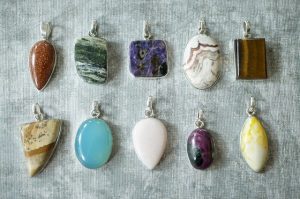
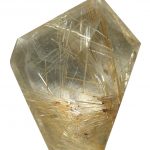
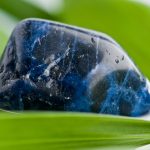
Quartz cat’s eye have a fibrous structure, with inclusions of crocidolite (blue asbestos) that cause a “cat’s-eye” effect known as chatoyancy. This effect is best seen when the stones are cut in cabochon. Each stone displays different colours according to the exact nature of the inclusions. The greyish yellow, semi-translucent appearance of quartz cat’s-eye is due to inclusions of crocidolite “asbestos” and, less commonly, hornblende. It has a silky lustre. Tiger’s eye is black, with iron oxide staining that gives yellow and golden brown stripes. Hawk’s eye forms when crocidolite changes to quartz, but the blue-grey or blue-green colour of the original remains.
Quartz cat’s-eye comes from Sri Lanka, India and Brazil. The most important source of of tiger’s eye is in South Aftica, where it is found in thick slabs, together with the less common hawk’s eye. Chatoyant quartz is also found in Australia and United States.
Chatoyant quartz is always called quartz cat’s eye to avoid confusion with other chatoyant gems, particularly chrysoberyl.




Leave a Reply
You must be logged in to post a comment.