
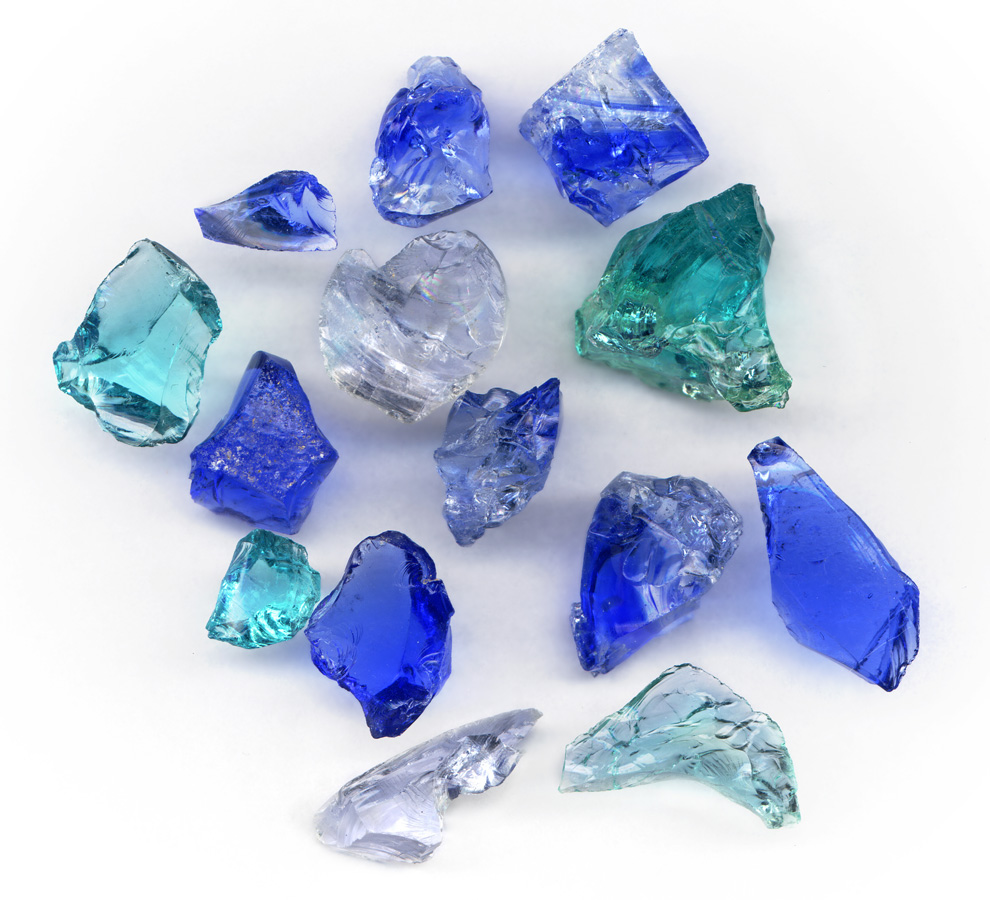
The manufacturing of glass consists of mixing the raw materials, including any colouring agent needed, to produce a mixture known as the batch and melting them together in special crucibles called pots. The liquid glass produced by this melting, known as a pot metal by the glass workers is then used as required. To obtain coloured glasses traces of colouring agent is mixed with the batch. Such colouring agents are usually, but not always, metallic oxides.
Glass is divided into two main types:
- Crown Glass: consisting of silicon, potash, soda, lime. This type of glass is used in making moulded imitation gems used in costume jewellery.
- Flint Glass: consisting of silicon, potash, lead oxide. These are the most important so far as gemstone imitations are concerned. The presence of lead increases the dispersion and brilliance.
Glass imitation stones may be made:
- from sheets or rods (lapidary cut stone),
- by moulding. The mould used is of iron; one half having the impressions of the crowns of the stones and the other half the pavilion. The mould is first oiled and then a layer of molten glass is spread upon the lower half and the mould closed. On cooling the mould is opened and the moulded stones removed.
Gemstones commonly imitated by glass:
- Transparent gemstones: All coloured as well as colourless (e.g., diamond, ruby, sapphire, emerald, alexandrite, peridot, rhodolite, etc.).
- Translucent to opaque gemstones: All coloured e.g., jadeite – “imori stone”, nephrite, turquoise, coral, lapis lazuli, shell, varieties of chalcedony.
- Phenomenal gemstones:
- Chatoyant: produced in many colours. Cat’s eye or cathaystone – contains long optical fibers that are packed with a hexagonal cross-section, producing a honeycomb effect. In cut stones this is commonly seen along the girdle.
- Aventurescent: Goldstone glass. Colourless glass containing brownish triangular or octagonal copper crystals producing a glittery effect and an overall brown to orange body colour; also made in a variety of colours.
- Play-of-Color: Slocum stone – glass with coloured foils producing the play of colour. Opal Imitation glass – iridescent metal foil irregularly sandwiched between two layers of glass causing play of color effect.
- Adularescent: glass with a satiny texture, resembling moonstone.
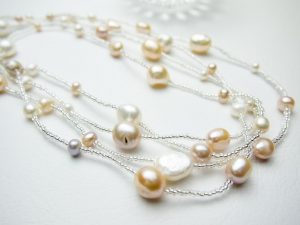
- Orient: various types of glass beads are produced, with or without iridescent coatings to imitate pearls.
Foil backed glass (Chatons / Rhinestone): Glass imitations are backed by metal foil in order to give a better reflection and brightness.
- The pavilion facets of the stone are backed by a mirror in a similar way as are ordinary glass mirrors.
- This is produced by a mercury amalgam which is then coated with a gold-coloured lacquer to keep the mirror surface from damage. Such foiled stones are called chatons.
- A vacuum sputtering process has been experimented with in an endeavor to replace the mercury amalgamation for foiling.
Paste: The significance of the world paste should be discussed. It is derived from the Italian pasta which means dough or food, and was formerly used exclusively for the cheapest types of glass imitation gems. Nowadays, it is indiscriminately used for all glass imitations of gems, and often for imitations in plastic.
The key to identifying both glass and plastic is being aware that these two materials are always possibilities. They may imitate any gem materials and have the same R.I. and S.G. as that material, yet they will not duplicate all of its optical, physical and chemical properties.
Properties of Glass
| Color / Variety | All colors. / Phenomenal varieties. |
| Transparency | Transparent to Opaque. |
| Hardness | 5 – 6 |
| Optic Character | Amorphous, shows A.D.R., S.R. or A.G.G. |
| S.G. | 2.30 – 4.50 |
| R.I. | Common Range: 1.48 – 1.70 Higher Range: 1.70 – 1.90 In general (not compulsory), a stone which is S.R. and has an R.I. within the range of 1.50 – 1.70 is a glass. |
| Dispersion | Variable. In some glasses strong dispersive fire is seen. |
| Magnification / Identification | Gas bubbles (spherical, oval, elongated, tubular); hemispherical cavities on the surface; flow lines (swirl marks); concave facets – orange peel effect (slightly pitted and uneven on surface); rounded face junctions (also seen in gemstones). |
| Luminescence | Variable, often chalky under ultra violet rays in both long wave and short wave. |
| Hot Point | No reaction, generally. |

Leave a Reply
You must be logged in to post a comment.